Current Activities

National Cancer Institute in New Mexico to Interview People Living at the Time of the 1945 Trinity Test

CCNS NEWS UPDATE

Runs 9/26/14 through 10/3/14


(THEME UP AND UNDER) This is the CCNS News Update, an overview of the latest nuclear safety issues, brought to you every week by Concerned Citizens for Nuclear Safety. Here is this week’s top headline:

  • National Cancer Institute in New Mexico to Interview People Living at the Time of the 1945 Trinity Test

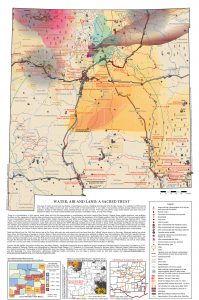
The National Cancer Institute (NCI) scientists are in New Mexico this week to interview a small group of Elders who were living at the time of the July 16th, 1945 Trinity atomic bomb test. These interviews are part of the Pilot Study, Phase One, of the NCI Trinity Study. http://dceg.cancer.gov/research/how-we-study/exposure-assessment/trinity The investigators will ask the Elders about the diet and life ways of the time, which could reveal ways that people were exposed to the fallout plume. The second phase will include the NCI scientists talking with focus groups, composed of those living under the fallout plume. A map of the plume is available at sacredtrustnm.org.

NCI is a division within the federal Health and Human Services Department. http://www.cancer.gov/ It is conducting the study to determine the cancer risks to the entire population living in New Mexico at the time. Because there is a lack of documentation about diets and ways of life of land-based Peoples in the 1940s, estimates of the radiation exposure cannot yet be made.

In 2007, then-Senator Jeff Bingaman wrote the Health and Human Services Department asking it for a range of the number of cancers that would be expected as a result of exposure to the radioactive fallout. He also asked for an estimate of the cancers that would occur naturally in the local New Mexico communities. Bingaman DHHS 10-30-07 HHS response Feb 21 2008 The interviews and focus group responses will assist in answering those questions.

Over the past year, Las Mujeres Hablan, a network of women led community organizations in New Mexico, has provided their time and expertise on a pro bono basis to inform and educate the NCI Trinity Study Team about community history, culture and experience in relationship to the Trinity test.

Las Mujeres Hablan members actively participated in the work of the Centers for Disease Control and Prevention in the ten-year Los Alamos Historical Document Retrieval and Assessment Project (LAHDRA). lahdra.org  Because the Trinity atomic weapon was developed at Los Alamos National Laboratory, the final LAHDRA report included an entire chapter about it. The report emphasized that approximately 4.8 kilograms, or over 10.5 pounds, of plutonium-239 did not fission. Because the detonation took place on a 50-foot tower, and not in the atmosphere, the plutonium more directly contacted the environment.  Las Mujeres Hablan has a special interest to make sure the unfissioned plutonium is addressed because the internal exposure to plutonium may be significant, especially for individuals exposed to heavy fallout and re-suspended dust particles.

To learn more about the study, please contact Silvia Salazar, the NCI Audience Research and Informatics Laboratory Manager at the Analytics and Audience Research Branch, at (240) 276-6631.


This has been the CCNS News Update. To learn more, please visit our website at nuclearactive.org.


LANL Plutonium Facility Is Priority Concern for DNFSB

CCNS NEWS UPDATE

Runs 9/19/14 through 9/26/14


(THEME UP AND UNDER) This is the CCNS News Update, an overview of the latest nuclear safety issues, brought to you every week by Concerned Citizens for Nuclear Safety. Here is this week’s top headline:

  • LANL Plutonium Facility Is Priority Concern for DNFSB

Citing its priority concerns across the nuclear weapons complex in a recent letter to the Department of Energy (DOE), the Defense Nuclear Facility Safety Board once again raised the vulnerability of the Plutonium Facility at Los Alamos National Laboratory (LANL) to a collapse and fire resulting from an earthquake.  In November 2012, LANL estimated that such an event could release radioactive materials to the public located off-site at a level of approximately 940 rems.  http://www.dnfsb.gov/sites/default/files/Board%20Activities/Reports/Site%20Rep%20Weekly%20Reports/Los%20Alamos%20National%20Laboratory/2013/wr_20130201_65.pdf  One rem is a large dose of radiation and exposure to 100 rems or more over a short amount of time can cause acute radiation syndrome and death.

DOE then proposed plans to mitigate the impacts of a possible catastrophic release, but has run into some yet-to-be-resolved problems. The mitigation measures could reduce the off-site exposures by 30 to 60 percent, but that would still mean a release of between 376 rems and 658 rems, which are still above DOE’s own 25 rem limit. Plutonium operations at the facility have been halted and portions restarted.

Kevin Roark, a LANL spokesperson, said, “Progress has been made over the summer toward resuming activities in [the Plutonium Facility] and we continue to work on resuming the remaining activities as quickly and safely as possible.”

In addition, the Board recently released a report about emergency preparedness and response of the DOE’s nuclear weapons complex.  http://www.dnfsb.gov/sites/default/files/Board%20Activities/Recommendations/rec_2014-1_25051_0.pdf   They state that emergency preparedness and response “is the last line of defense to prevent public and worker exposure to hazardous materials.”

And the DOE Inspector General recently released a report entitled, “The Readiness of the Department’s Federal Radiological Monitoring and Assessment Center,” about emergency preparedness.  http://energy.gov/sites/prod/files/2014/08/f18/S13IS012%20FRMAC%20Final%20Report%2008282014_1.pdf

The Board cites problems that are similar to those experienced during the May 2000 Cerro Grande fire at LANL when DOE emergency response personnel left about half of the portable air monitors on the tarmac in Nevada. They never went back to get them, and as a result, many areas under the enormous smoke plume were not monitored. Further, DOE did not monitor the smoke plume even though it was one of its emergency response requirements to send radiation monitors up in planes. These are a few examples of the types of systematic problems encountered in February at the Waste Isolation Pilot Plant (WIPP) when two events occurred involving a fire and radiation release.

Joni Arends, of CCNS, said, “There are so deficiencies in the DOE’s emergency response capabilities, equipment maintenance and replacement, and training that must be addressed now. In order to operate facilities handling plutonium, all emergency response capabilities must be in tiptop condition. Congress must provide priority emergency preparedness funding to DOE before funding any expansion of nuclear weapons production. What is national security if we can’t protect ourselves from potential catastrophic events at facilities designed to protect national security?”


This has been the CCNS News Update. To learn more, please visit our website at http:// www.nuclearactive.org.


WIPP Recovery Information to be Released Next Week

CCNS NEWS UPDATE

Runs 9/12/14 through 9/19/14

(THEME UP AND UNDER) This is the CCNS News Update, an overview of the latest nuclear safety issues, brought to you every week by Concerned Citizens for Nuclear Safety. Here is this week’s top headline:

* WIPP Recovery Information to be Released Next Week

Information about the Waste Isolation Pilot Plant (WIPP) recovery plans will be released next week at a New Mexico Legislative Committee Meeting on Tuesday, September 16th and at the WIPP Town Hall on Thursday, September 18th, both of which will be held in Carlsbad, New Mexico. It is anticipated recovery would take at least two years following the February 14th release of plutonium and americium from at least one waste container shipped by Los Alamos National Laboratory (LANL) that exploded in the underground dump for nuclear bomb waste.

On Tuesday, September 16th, the interim Radioactive and Hazardous Materials Committee of the New Mexico Legislature will meet at the Western Commerce Bank Community Room, located at 3010 National Parks Highway in Carlsbad, from 10 am to 5 pm.  http://www.nmlegis.gov/lcs/committee_detail.aspx?CommitteeCode=RHMC  In the morning, presentations will be made by Dana Bryson, the Department of Energy (DOE) Carlsbad Field Office Deputy Manager, about the status of WIPP, and by Terry Wallace, the LANL Principal Associate Director for Global Security, about the status of LANL.

In the afternoon, presentations will be made by Don Hancock, of Southwest Research and Information Center, about the environmental response; by Russell Hardy, Director of the Carlsbad Environmental Monitoring and Research Center, New Mexico State University, about the WIPP monitoring; and by Ryan Flynn, Secretary of the state Environment Department, and their consultant, Dr. Ines Triay, about the Environment Department response. Dr. Triay is the former manager of WIPP.

In recent weeks Environment Department Secretary Flynn has expressed frustration with DOE because they have not provided all of the requested information. As a regulator of WIPP and LANL, the Environment Department can impose fines and penalties on both sites. Flynn said that DOE has been muzzling scientists who possess critical information.

On Thursday, September 18th at 5:30 pm MST, the DOE will discuss its WIPP recovery activities, but not release the Recovery Plan, during the bimonthly town hall meeting at the Carlsbad City Hall. It will be webcast at http://new.livestream.com/rrv

The Recovery Plan has been under review by DOE Headquarters for months. Some recovery activities have already taken place, including radiological surveys of the mine floor and putting the waste hoist back into service. Recently, workers began preparations to resume maintenance work on the rock bolts used to hold the ceiling in place, but first they are doing maintenance on the equipment needed to do the work.

Don Hancock, of Southwest Research and Information Center, said, “The WIPP underground cannot be completely decontaminated. The Recovery Plan should describe what DOE deems acceptable levels of cleanup and worker exposure. It should also provide realistic costs and schedules for the proposed activities and be subject to public review.”  http://www.sric.org


This has been the CCNS News Update. To learn more, please visit our website at http://www.nuclearactive.org.


Eighteenth Annual Gathering for Mother Earth to be Held September 27th and September 28th in Pojoaque

2014 Gathering for Mother Earth flyer

2014 Gathering for Mother Earth flyer

CCNS NEWS UPDATE
Runs 9/5/14 through 9/12/14

(THEME UP AND UNDER)  This is the CCNS News Update, an overview of the latest nuclear safety issues, brought to you every week by Concerned Citizens for Nuclear Safety.  Here is this week’s top headline:

*   Eighteenth Annual Gathering for Mother Earth to be Held September 27th and September 28th in Pojoaque

The eighteenth annual Gathering for Mother Earth, sponsored by Tewa Women United, is scheduled for Saturday and Sunday, September 27th and 28th, in Pojoaque. The event, which is open to the public of all cultures of all ages, seeks to honor Mother Earth for her lifegivingness.  The Gathering is a time for community unity to protect the most vulnerable people, including pregnant women, infants and farmers, especially those living around production sites for nuclear weapons.  http://tewawomenunited.org/

Both days will begin with a sunrise service at 6:30 am.  Saturday’s scheduled program will begin around 9 am and include mini-gathering circles and workshops, ending around 5 p.m.  Local Native dancer groups and others will perform, including Jon Naranjo’s Family Dancers, The Danza Mexika Dancers, Indigie Femme and others, Beverly Doxtator of Native Lifeways, Inc., and Katia Delgado and others from Peru who will grace attendees with their spiritual wisdom.

A delicious communal meal will be provided, followed by entertainment by local poets from 100,000 Poets for Change.

The Sunday sunrise service will include a blessing for the relay runners participating in the Sacred Relay Run.  At 7:30 am, the runners will begin the run at Tsankawi, the ancestral Pueblo homelands near Los Alamos, and end at the Gathering site.

At 10 am there will be Memorials for Beloved Elders and Youth Leader.  Tributes will be given for the Late Beloved Vincent Harding and Late Elder Johnson Bluehorse.  A Tribute for Youthful Loss will be given for Victor Villalpando, the 16-year old El Rito youth shot and killed by an Espanola police officer in June.

The Gathering will close around 1 pm when there will be a traditional distribution of gifts.

Kathy Sanchez, of Tewa Women United and organizer of the Gathering, said, “Let us all celebrate cultural ways of sharing love and gratitude for our Earth Mother — to show love for her will heal our hearts of grief and overwhelming sense of loss we feel as violence pressures us to be numb and do violence to ourselves and others.  It is time to unite for eco-systemic revival.”

She added, “The emphasis of the Gathering is on healing Mother Earth to bring sacredness back into our homes of earth-based living.  We need to encourage all cultures, all ages, schools, communities and families to bring intergenerational thinking to holistic ways of active healing.”

The Gathering will be held at Pojoaque Ben’s Gathering Grounds on Highway 502, 1.8 miles west of the interchange with Highways 285 and 84, near the Pojoaque High School.  Please bring your own dishes and water bottle.  To volunteer, please call (505) 747-3259.

This has been the CCNS News Update.  To learn more, please visit our website at www.nuclearactive.org.


Join the Nuclear-Free, Carbon-Free Contingent at the September 21st People’s Climate March in New York City


CCNS NEWS UPDATE
Runs 8/29/14 through 9/5/14

(THEME UP AND UNDER)  This is the CCNS News Update, an overview of the latest nuclear safety issues, brought to you every week by Concerned Citizens for Nuclear Safety.  Here is this week’s top headline:

*  Join the Nuclear-Free, Carbon-Free Contingent at the September 21st People’s Climate March in New York City

On September 21, 2014, the Nuclear-Free, Carbon-Free Contingent will join the historic People’s Climate March in New York City to demand immediate action from all of the governments of the world to slash climate-changing emissions in all sectors of society.  They say that nuclear power cannot solve the climate crisis and that its continued use exacerbates the problem by preventing the deployment of clean energy systems.  Their slogan is “No Nukes, No Coal, No Kidding!  Don’t Nuke the Climate!”

The Nuclear Information and Resource Service, based in Takoma Park, Maryland, is taking the lead for the Contingent.  They say that a nuclear-free, carbon-free energy system is a necessity and define it as a “system that relies not on antiquated energy models of the 20th century and their polluting nuclear power and fossil fuel technologies, but on a safe, clean, affordable and sustainable renewable energy, energy efficiency, and modern grid technologies of the 21st century.”

They argue that nuclear power is too dangerous, too dirty, too expensive and too slow.  It is too dangerous because expanded use would inevitably lead to more Fukushimas and Chernobyls.  New designs for nuclear reactors exist only on paper and cannot be brought to the commercial marketplace in time to have a meaningful impact on climate change.  Further, the technology and materials needed to generate nuclear energy can be diverted to nuclear weapons programs.

Nuclear power is too dirty because the nuclear fuel chain produces vast amounts of lethal radioactive and toxic waste.  The nuclear fuel chain is responsible for far more carbon emissions than renewable energy generation and improved energy efficiency.

Nuclear power is the most expensive means possible for reducing carbon and methane emissions.  Its use crowds out investment in clean energy sources.

Construction of nuclear power plants would require an unprecedented nuclear construction program, which would be beyond the capability of the world’s manufacturers within an acceptable time frame.

The Contingent argues that “clean energy, including solar, wind, appropriately-sited geothermal, increased energy efficiency, distributed generation, electricity storage and other advanced technologies, can meet the world’s electricity needs without radiation releases, carbon and methane emissions and other pollutants.  All that is lacking is the political will to rapidly deploy these clean technologies.”

You are cordially invited to be part of the largest, most visible outpouring of public support ever for immediate action on the climate crisis and against nuclear power as a counterproductive climate solution.  Michael Marriott, of the Nuclear Information and Resource Service, wrote that the March “can be the largest anti-nuclear power outpouring in decades-but that depends on you.”  For more information, please visit nirs.org.

This has been the CCNS News Update.  For more information, please visit nuclearactive.org and like us on Facebook.


WIPP Worker Harmed by Vehicle Fire Sues Operators for Negligence


CCNS NEWS UPDATE
Runs 8/22/14 through 8/29/14


(THEME UP AND UNDER)  This is the CCNS News Update, an overview of the latest nuclear safety issues, brought to you every week by Concerned Citizens for Nuclear Safety.  Here is this week’s top headline:

* WIPP Worker Harmed by Vehicle Fire Sues Operators for Negligence

William Utter, a waste handler at the Waste Isolation Pilot Plant (WIPP), and his family filed a personal injury lawsuit in the New Mexico District Court in Santa Fe against the current and former contractors for injuries sustained when the salt hauling truck caught fire on February 5, 2014.   Utter continues to suffer from smoke inhalation and other injuries.  The family is suing Southwest Safety Specialists, Inc., a company charged with maintaining the fire suppression system; Nuclear Waste Partnership, LLC, the current operating contractor; Washington TRU Solutions, LLC, the previous operating contractor; and URS Energy and Construction, the lead partner operating contractor; for personal injury, negligence, premises liability, intentional and willful conduct, loss of consortium, damages, and punitive damages.  The Utters are asking for a six-person jury trial.  Utter v. Southwest Safety Specialists, Inc., Nuclear Waste Partnership, LLC, Washington TRU Solutions, LLC, URS Energy & Construction, Inc.

Utter was in the underground mine when the salt hauling vehicle caught on fire.  He was among the 86 workers who were evacuated, some who had difficulty seeing the markers indicating the way to the elevator hoist to exit the mine located 2,150 feet below the surface.  Utter was one of the 13 workers who were treated for smoke inhalation.  He continues to be treated by respiratory specialists in Albuquerque and Denver.

The complaint relies upon the facts uncovered during the internal Department of Energy (DOE) investigation by the Accident Investigation Board.  http://energy.gov/em/articles/doe-finalizes-wipp-fire-investigation-report  It found that the underground mine fire was entirely preventable and that the DOE and its WIPP contractors created dangerous conditions for the workers.

The salt hauling truck is nearly 30 years old.  In 2003, Southwest Safety Specialists removed the automatic fire suppression system from the truck and installed a manual fire suppression system, which failed to perform properly.  In 2005, there was another fire involving this vehicle, caused by an electrical short.  Nevertheless, the contractors did not reinstall the automatic fire suppression system.

On February 5th, the truck operator tried to use the manual fire suppression system and a portable fire extinguisher, which both failed.  As a result, the fire created and spread extensive smoke, soot, toxins, and other dangerous airborne particulates and chemicals in the underground.  Further, the evacuation alarm was not adequate, the public address system did not work properly, and the contractors switched the air system from ventilation to filtration, contrary to standard mine safety requirements.  DOE and its contractors did not adequately train the workers for underground fires and some workers struggled with using the self-rescue respiratory masks.

Nuclear Waste Partnership became the operating contractor in October 2012 for a five-year contract term, with a five-year extension option through September 30, 2022.  The possible value of the 10-year contract exceeds $1.3 billion.

This has been the CCNS News Update.  For more information, please visit http://www.nuclearactive.org and like us on Facebook. 


New Mexicans Attend the Compliance Review of the United States by the United Nations Committee on the Elimination of Racial Discrimination in Geneva


CCNS NEWS UPDATE
Runs 8/15/14 through 8/22/14

(THEME UP AND UNDER)  This is the CCNS News Update, an overview of the latest nuclear safety issues, brought to you every week by Concerned Citizens for Nuclear Safety.  Here is this week’s top headline:

*  New Mexicans Attend the Compliance Review of the United States by the United Nations Committee on the Elimination of Racial Discrimination in Geneva

This week delegations from around the world and New Mexico presented to the United Nations Committee on the Elimination on Racial Discrimination (CERD) during their review of treaty compliance by the United States.  The CERD is an 18-member UN Treaty body that monitors compliance with the International Convention on the Elimination of All Forms of Racial Discrimination.  Over 175 State Parties ratified the Treaty.  The U.S. ratified it in 1994 and is bound by all provisions of the Treaty.  The Committee received alternative information from New Mexicans, including representatives from the South West Organizing Project (SWOP), http://www.swop.net/, and the Multicultural Alliance for a Safe Environment (MASE), http://masecoalition.org/, which directly challenged the U.S. assessment of its compliance.

In June 2013, the U.S. submitted a compliance report to the CERD.  In June of this year, Albuquerque-based SWOP, and MASE, a network of organizations based in the Grants uranium belt, submitted alternative or shadow reports to the Committee.

The MASE shadow report addressed uranium mining and milling wastes that, after more than 30 years, still have not been remediated in Milan, Church Rock, and throughout northwestern New Mexico.  The unremediated wastes keep contaminating the air, land and water, while at the same time the U.S. government and state governments continue to permit new uranium mines.  The impacts from both historic waste and new mining fall primarily on Indigenous communities.

The SWOP report outlines the unequal implementation and enforcement of air pollution laws in Albuquerque and Bernalillo County by local regulatory agencies and the U.S. Environmental Protection Agency (EPA).  Local laws effectively segregate low-income and minority populations into neighborhoods that face high pollution and high health risks.  For example, community efforts to sample the air in the San Jose neighborhood revealed that concentrations of the volatile organic compound chlorobenzene are 10 times higher than concentrations typically found in urban ambient air and are above the reference concentrations of the EPA.  Chlorobenzene is a solvent and long-term exposure of humans affects the central nervous system.  In the Mountain View neighborhood, there are more cases of lung, bladder, and brain cancer and leukemia than statistically expected.  These neighborhoods do not have adequate means to seek redress from their unequal treatment under the current interpretation of federal environmental and civil rights laws.

After the review process, CERD will publish its Concluding Observations, which include recommendations for actions the U.S. should take to fulfill its commitment under the treaty to eliminate racial discrimination in its policies and practices.  The CERD Concluding Observations along with the Alternative Reports are available online: http://www2.ohchr.org/english/bodies/cerd/.

This has been the CCNS News Update.  For more information, please visit http://www.nuclearactive.org and like us on Facebook.


DOE Secretary Moniz to Visit New Mexico Early Next Week

CCNS NEWS UPDATE

Runs 8/8/14 through 8/15/14

(THEME UP AND UNDER) This is the CCNS News Update, an overview of the latest nuclear safety issues, brought to you every week by Concerned Citizens for Nuclear Safety. Here is this week’s top headline:

  • DOE Secretary Moniz to Visit New Mexico Early Next Week

On Monday, Ernest Moniz, the Department of Energy (DOE) Secretary, will be in New Mexico to meet with elected officials and regulators, make opening remarks at a public meeting about energy in Santa Fe and hold a public town hall in Carlsbad about the fire and radiation release that occurred in February at the Waste Isolation Pilot Plant (WIPP). On Tuesday, he will visit WIPP. http://www.wipp.energy.gov/wipprecovery/recovery.html

On Monday, August 11th, Secretary Moniz will attend a Quadrennial Energy Review meeting in Santa Fe. The Quadrennial Energy Review, which was launched by the Obama administration in January, is a broad effort to provide recommendations about the key infrastructure needed for the transmission, distribution and storage of energy. Interior Secretary Sally Jewell and Senator Martin Heinrich will participate in the meeting, which will focus on tribal, state and local issues. It will take place at the New Mexico State Personnel Office, located at 2600 Cerrillos Road, in Santa Fe, beginning at 9 am.  http://energy.gov/articles/secretary-moniz-announces-travel-chicago-north-dakota-new-mexico-quadrennial-energy-review

Also on Monday, Secretary Moniz will host a town hall meeting at the Leo Sweet Community Center, located at 1302 Mission Avenue, in Carlsbad, beginning at 6:30 pm. The town hall will be livestreamed at new.livestream.com/rrv  The focus will be on the recovery efforts at WIPP following the truck fire on February 5th and the radiation release on February 14th. Plutonium and americium was detected in air filters located one-half mile away from the WIPP exhaust shaft. Twenty-two workers were exposed to the radiation.

Photographs have shown a waste drum from Los Alamos National Laboratory released radioactivity in the WIPP underground. Further investigations will take place in the coming weeks to try to determine if other containers also are breached. The cause of the release is still not known, so whether additional releases might occur in the future also is unknown.

DOE is developing a plan to detail what activities it will undertake in order to decontaminate the underground and resume waste disposal operations. The plan also is supposed to provide cost estimates and schedules for those activities. The plan has not been made public, but may be a subject of discussion during Secretary Moniz’s visit.

WIPP is the federal government’s only site for the permanent disposal of nuclear and hazardous waste generated by the research, development and manufacture of nuclear weapons and is located 2,150 feet below land surface in a salt formation located 26 miles east of Carlsbad.  http://www.wipp.energy.gov/index.htm

Ryan Flynn, the Secretary of the New Mexico Environment Department, will attend the events in Carlsbad. Flynn said he is interested in learning about how DOE will provide improved oversight of nuclear safety, emergency management and mine safety at the WIPP site.  http://www.nmenv.state.nm.us/


This has been the CCNS News Update. For more information, please visit nuclearactive.org and like us on Facebook.


Trinity Site Atomic Bomb Test Commemoration in Tularosa


CCNS NEWS UPDATE

Runs 8/1/14 through 8/8/14

(THEME UP AND UNDER) This is the CCNS News Update, an overview of the latest nuclear safety issues, brought to you every week by Concerned Citizens for Nuclear Safety. Here is this week’s top headline:

  • Trinity Site Atomic Bomb Test Commemoration in Tularosa

About 70 people attended the Fifth Annual Luminaria Lighting and Prayer Vigil in Tularosa, New Mexico, on Saturday, July 26th in commemoration of the Trinity Site Atomic Bomb Test. Trinity was the site of the first experimental test of the atomic bomb on July 16, 1945, at what is now known as the White Sands Missile Range. It led to the U.S. bombing of Hiroshima, Japan on August 6th of that same year.

The Tularosa Basin Downwinders Consortium, in cooperation with the Village of Tularosa, organized the public event at the Tularosa Little League Field. More than 150 luminarias were lit in memory of those who lost their lives to cancer and other radiation related illnesses directly linked to the test explosion. At least half of the people in attendance were cancer survivors and those living with cancer.

One lone luminaria was placed in the center of the field in honor of Fred Tyler, co-founder of the Tularosa Basin Downwinders Consortium. Tyler died earlier this year of a lung disease.

The Consortium formed in order to ensure that those exposed to the test be covered by the federal Radiation Exposure Compensation Act (RECA), which has provided compensation for other impacted communities downwind of the Nevada Test Site and the Marshall Islanders for over 20 years. New Mexico Senator Tom Udall has led the effort to introduce amendments to RECA that would include the Trinity downwinder.

Senator Udall’s Senate speech acknowledging the work of the Consortium in support of expansion of RECA was played at the event. Udall said, “The original RECA bill required years of work on the ground. My father, [Stewart Udall], helped lay the groundwork for RECA a quarter century ago through his work with radiation exposure survivors and their families, compiling stories, records and histories of victims. The Tularosa Basin Downwinders Consortium continues this critical work, and I encourage them to keep up the fight. This is a bipartisan effort and driven by simple fairness for American citizens who should have been helped, but were ignored instead.”    http://www.tomudall.senate.gov/?p=press_release&id=1719

Concerning the memorial event, Tina Cordova, a co-founder of the Consortium, said, “Every time I see all the luminarias with names and learn of another person who has passed I lament. Every time I learn of another neighbor stricken with cancer I am saddened. We will keep the vigil going until the time that our Congressional Representatives are present to lament with us and we receive the recognition of our suffering that we’ve waited 69 years for.”

For more information about the work of the Consortium, please contact Tina Cordova at 505-897-6787 or tcordova@queston.net


This has been the CCNS News Update. For more information, please visit our website at nuclearactive.org or our Facebook page.


Navajo Grassroots Organizations Celebrate Navajo Nation Council Vote Stopping Pro-Uranium Mining Legislation

CCNS NEWS UPDATE

Runs 7/25/14 through 8/1/14

(THEME UP AND UNDER) This is the CCNS News Update, an overview of the latest nuclear safety issues, brought to you every week by Concerned Citizens for Nuclear Safety. Here is this week’s top headline:

* Navajo Grassroots Organizations Celebrate Navajo Nation Council Vote Stopping Pro-Uranium Mining Legislation

This week the Navajo Nation Council’s Resources and Development Committee voted down a bill that would have opened up new uranium mining on lands adjacent to those of the Navajo Nation. In related action and in a vote of 18 to 3, the Navajo Nation Council approved a bill by Edmund Yazzie, a Council Delegate representing Churchrock, which provides for a more open and democratic process regarding uranium issues. The bill sets a precedent that all uranium-related bills must be heard before the full Council.

The votes fortify the Diné Natural Resources Protection Act, passed by the Navajo Nation Council in 2005, which placed a moratorium on all forms of uranium mining within Navajo Indian Country. A coalition of Navajo grassroots organizations opposed to uranium mining, called Concerned Diné Citizens, who worked together to defeat the bad legislation sponsored by former New Mexico State Senator and current Navajo Council Delegate Leonard Tsosie and supported Delegate Yazzie’s legislation securing community and ecological sovereignty.

For over two decades, Uranium Resources, Inc. (URI) has proposed to mine for uranium using an in-situ leaching methods in the Churchrock area. This proposition would contaminate the communities source of unspoiled drinking water derived from a below ground drinking water aquifer. In-situ uranium mining is similar to oil fracking, in that chemicals and large quantities of water are used to extract the uranium. In addition, radioactive radon is released into the air and heavy metals are mobilized through the leaching process.

Last year, the Churchrock Chapter passed a resolution that allowed URI to set up an in-situ leach uranium mining demonstration project on lands adjacent to the Navajo Nation in Churchrock. Over the years, there have been several attempts to limit the decision making processes around this project to fewer and fewer people. Thus, the vote on the Yazzie bill allows for more decision makers to be involved.

Uranium mining boomed in the 1950s and 1960s in the Grants uranium belt. The mines operated before the Clean Water Act was passed and before the Environmental Protection Agency was formed. Cleanup of the uranium mines and mills was required. Now, 137 of 259 of the known mines have no records of remediation, and Navajo families are living with the side effects.

Leona Morgan, an organizer for Diné No Nukes, said, “Now the Nation’s focus can go back to the over whelming needs for clean up, health studies, and water studies. In order for these controversial issues not to play out so divisively in the future, it is imperative that all people—not just Diné people—understand the scope and permanent effects of abandoned uranium mines.”


This has been the CCNS News Update. To support the work of CCNS, please make your tax-deductible contribution at http://www.nuclearactive.org.