Current Activities

Plutonium Experiments May Begin this Month at the National Ignition Facility


CCNS NEWS UPDATE

Runs 1/23/15 through 1/30/15

(THEME UP AND UNDER) This is the CCNS News Update, an overview of the latest nuclear safety issues, brought to you every week by Concerned Citizens for Nuclear Safety. Here is this week’s top headline:

  • Plutonium Experiments May Begin this Month at the National Ignition Facility

Weaponeers at Lawrence Livermore National Laboratory may begin experiments using plutonium in the world’s largest and most expensive laser facility, the National Ignition Facility (NIF), at the end of this month. Longer-lived forms of plutonium-242 or 244 may be substituted for weapons-grade plutonium-239 in the poppy seed sized targets that will be focused and fired onto by 192 laser beams. The Department of Energy (DOE) estimates that over the next decade, they will conduct at least 100 experiments, or “shots,” where plutonium would be vaporized.

The classified or unclassified experiments will be conducted in the $3.5 billion laser facility, operated by the DOE’s semi-autonomous National Nuclear Security Administration at the Livermore Laboratory, located about 50 miles east of San Francisco.

Over the years, the NIF mission has changed. The original plans included having plutonium shots contained in a small round containment vessel to surround the experiment. The vessel would capture the radioactive debris. But due to apparent technical difficulties getting laser beams inside the small vessel, DOE jettisoned the containment vessel plan and are now planning to do experiments in the NIF target chamber without additional containment.

Tri-Valley Communities Against a Radioactive Environment, or Tri-Valley CARES, a Livermore, California based non-governmental organization has brought attention to the NIF ever since it was first proposed over two decades ago. To learn more, please visit http://www.trivalleycares.org/

Tri-Valley CARES filed Freedom of Information Act requests for documents about the experiments. In recently received documents, they uncovered many of the assumptions DOE made to escape addressing worst-case scenarios. For example, Livermore will be allowed to “splatter” the longer-lived plutonium inside the NIF without an effective means of containment by assuming the airborne radioactivity will not exceed legal limits. At the same time DOE says the experiments may “generate airborne contamination that exceeds the [legal limit].”

Further, DOE says the proposed experiments could contaminate the laser optics. One DOE report questions whether it is even possible to clean debris off the optics.

It appears they is using the same type of thinking for the NIF shots as it has for the Waste Isolation Pilot Plant (WIPP), a DOE disposal facility for plutonium-contaminated bomb waste, located near Carlsbad, New Mexico. DOE assumed that WIPP would not leak and as a result did not plan for such an event. But last February WIPP did leak and the underground was contaminated when one or more waste drums exploded. DOE anticipates that WIPP may reopen in 2016 at a cost of over $1 billion.

The proposed uncontained plutonium shots in the NIF could also leak and contaminate the laser facility. DOE will not conduct any additional environmental review before the experiments begin.


This has been the CCNS News Update. To learn more, please visit our website at http://www.nuclearactive.org


Update:  See January 28, 2015 Press Release:  “Tri-Valley CAREs & NRDC Ask Energy Secretary to Halt Plutonium “Shots” in NIF Scheduled to Begin Thursday at Livermore Lab – Groups’ Attorneys Cite Unaddressed Plutonium Exposure Risks and Nuclear Non-Proliferation Concerns.”   http://www.trivalleycares.org/new/NIF_PU_PR.pdf
 

New Tools Needed for Nuclear Nonproliferation and Verification

CCNS NEWS UPDATE

Runs 1/16/15 through 1/23/15

(THEME UP AND UNDER) This is the CCNS News Update, an overview of the latest nuclear safety issues, brought to you every week by Concerned Citizens for Nuclear Safety. Here is this week’s top headline:

* New Tools Needed for Nuclear Nonproliferation and Verification

This week, nonproliferation expert, Dr. James Doyle, released his study, “Essential Capabilities for Nuclear Security:  A National Program for Nonproliferation and Verification Technology Development,”  that supports expansion of U.S. nonproliferation programs as essential for nuclear security. Expansion includes the development and/or deployment of new and existing verification and monitoring technologies that would help make a future world free of nuclear weapons more technically and politically feasible. Doyle argues that it should be funded as a core aspect of the nation’s nuclear infrastructure modernization plan, and implemented jointly by the National Nuclear Security Administration (NNSA) and Department of Defense, with guidance from the State Department, intelligence community and National Academy of Sciences.  http://nukewatch.org/importantdocs/resources/Doyle-EssentialNuclearSecurityReport.pdf

In recent years Congress cut funding for nonproliferation programs, while providing funding for modernization of the nuclear weapons complex, including large construction projects that are over-budget and behind schedule.

Doyle said, “As America allegedly reduces its reliance on nuclear weapons and hopefully further reduces the size of its stockpile, it needs new tools and new capabilities to keep weapons and materials secure and verify that other nations are complying with similar obligations. To meet these needs a new, integrated multiagency program to develop nonproliferation, verification and monitoring technologies for nuclear security should be initiated without delay.”

Doyle continued, “Nonproliferation and arms verification have for too long been considered ‘soft power’ tools of the diplomatic and arms control communities. Real nuclear security requires that we now consider these capabilities as vital elements of our national security infrastructure. They are potent ‘smart power’ tools offering unique advantages in a rapidly evolving nuclear security environment, which unfortunately includes the threat of nuclear terrorism. Aggressive verification and monitoring technologies will produce a far greater national security return on the taxpayer dollar than will exorbitant ‘modernization’ programs for an unnecessarily oversized nuclear arsenal.”

Doyle’s latest study was written in collaboration with Nuclear Watch New Mexico and funded by the Ploughshares Fund. For more information, please visit http://www.nukewatch.org

Jay Coghlan, of Nuclear Watch, said, “The nuclear weapons establishment is planning to spend more than a trillion dollars to ‘modernize’ existing weapons, and build new missiles, subs and bombers. Meanwhile, the NNSA is cutting nonproliferation and dismantlement programs to help pay this colossal bill. This is exactly upside down. We should be making smart investments into new nonproliferation, verification and monitoring technologies that will help make a world free of nuclear weapons feasible, eliminating the threat for all time.”

While in Washington, DC this week, Doyle met with the Department of Energy officials about his whistleblower complaint regarding termination from Los Alamos National Laboratory (LANL) after his study entitled “Why Eliminate Nuclear Weapons?” was published. LANL initially cleared his study for release, but then retroactively classified it, even though it was readily available on the Internet.


This has been the CCNS News Update. To learn more, please visit our website at www.http://www.nuclearactive.org.


WIPP Problems Highlighted in Two DOE Independent Assessments

CCNS NEWS UPDATE

Runs 1/9/15 through 1/16/15

(THEME UP AND UNDER) This is the CCNS News Update, an overview of the latest nuclear safety issues, brought to you every week by Concerned Citizens for Nuclear Safety. Here is this week’s top headline:

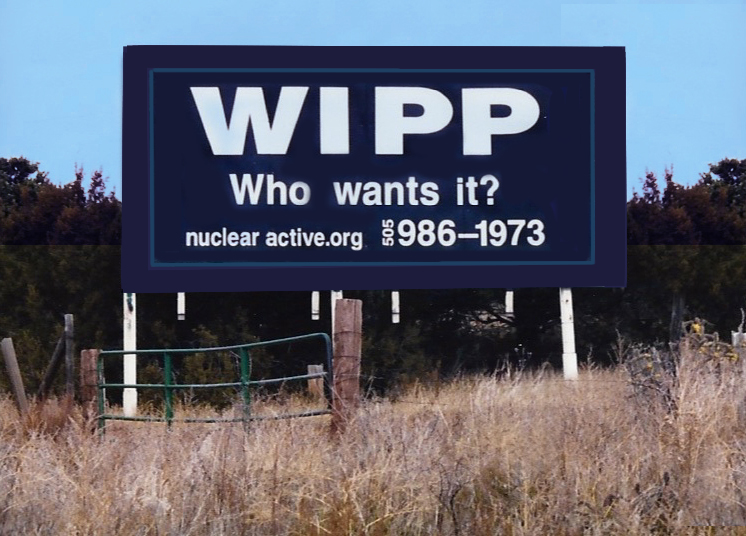
* WIPP Problems Highlighted in Two DOE Independent Assessments  WIPP Billboard 1998 © s.westerly

Running a nuclear facility requires periodic equipment maintenance, reviews of safety systems, and extra precautions in order to protect workers, the public and the environment from releases of dangerous radioactive and chemical materials. It is imperative that owners and operators of nuclear facilities make these a priority. Unfortunately, this is not the case for the Nuclear Waste Partnership, a limited liability corporation and contractor for the Waste Isolation Pilot Plant (WIPP), an underground nuclear waste dump located 2,150 feet below the surface in a salt formation 26 miles east of Carlsbad, New Mexico.

In two internal reviews, the U.S. Department of Energy (DOE), the owner of WIPP, found additional problems with the contractor’s work at the site when in February 2014 there was a vehicle fire in the underground and nine days later, a release of plutonium and americium, which contaminated portions of the underground and the surface, when one or more waste drums exploded.

WIPP has not received any shipments since then. It is anticipated to take years and more than $1 billion before any waste is transported for disposal. In September, DOE released a Recovery Plan to resume operations. Unfortunately, the plan is not complete, and the first opportunity for public comment will be on January 14th.   http://www.wipp.energy.gov/Special/WIPP%20Recovery%20Plan.pdf

The DOE Office of Enterprise Assessments conducted the two reviews. One review focused on operating diesel equipment, such as salt haulers and machines for installing long bolts into the ceiling, in the underground. Since February the mine has been operating with about one-seventh of the standard airflow, which may be below what is necessary to keep workers safe. The review states, “The most significant concern is that [the contractor] does not have a sound engineering approach for determining the minimum ventilation rates that will ensure safe conditions for underground workers.”

Also, the WIPP Ventilation Plan does not meet U.S. Mine Safety and Health Administration requirements. In particular, the contractor had been using non-approved diesel engines that were banned in 2001. The review states, “[t]he identified deficiencies are significant and need to be addressed before WIPP begins to use diesel engines underground.”  http://www.energy.gov/sites/prod/files/2014/12/f19/2014_WIPP_Recovery_Plan_for_Diesel_Equipment_-_December_2014.pdf

The other review points out how the contractor did not conduct basic equipment maintenance as required by DOE orders and the management contract.  http://www.energy.gov/sites/prod/files/2014/12/f19/2014_-_WIPP_Conduct_of_Maintenance_Recovery_Plan_-_December_2014.pdf

Because of the problems in 2014, DOE may not pay $8 million in performance bonuses. But the contractor was paid more than $140 million, which is $7 million more than the amount specified when the contract was awarded in 2012. Further, some of the performance measures for 2015 do not match those in the WIPP Recovery Plan, so that the contractor would receive performance bonuses even when it does not meet the milestone schedules.


This has been the CCNS News Update. To learn more, please visit our website at http://www.nuclearactive.org


DOE Considers a Ten-Fold Increase of Plutonium in CMRR Rad Lab at LANL

CCNS NEWS UPDATE

Runs 1/2/15 through 1/9/15

(THEME UP AND UNDER)  This is the CCNS News Update, an overview of the latest nuclear safety issues, brought to you every week by Concerned Citizens for Nuclear Safety.  Here is this week’s top headline:

DOE Considers a Ten-Fold Increase of Plutonium in CMRR Rad Lab at LANL

After having successfully given itself permission to more than quadruple the amount of weapons-grade plutonium allowed in the Chemistry and Metallurgy Research Replacement (CMRR) Radiological Laboratory Utility Office Building (RLUOB), the Department of Energy, through its semi-autonomous National Nuclear Security Administration, recently asked Los Alamos National Laboratory to conduct an analysis to determine if the RLUOB could hold up to 400 grams of plutonium-239.  In a memo written in late October, NNSA Deputy Administrator for Defense Programs, Don Cooke, requested LANL to investigate whether it would be possible to increase the amount of plutonium from 38.6 grams to 400 grams, a more than ten fold increase. Cook expects LANL to complete the review by mid-March, 2015.  http://www.dnfsb.gov/sites/default/files/Board%20Activities/Reports/Site%20Rep%20Weekly%20Reports/Los%20Alamos%20National%20Laboratory/2014/wr_20141024_65.pdf

There are many concerns about the NNSA proposal.  One is the lack of a public process for review and comment of the proposal.  The last time the public reviewed the amount of plutonium allowed in the RLUOB was during the 2011 environmental impact statement process for the CMRR Project.  NNSA proposed to increase the production of the plutonium triggers for nuclear weapons in the CMRR from 20 to 50 to 80 per year.  And this was after President Obama announced in Prague his plan to reduce the number of nuclear weapons, for which he was awarded the Nobel Peace Prize.  In 2012 President Obama put the proposed Super Walmart sized CMRR Nuclear Facility on hold for five-years, essentially canceling the construction.

NNSA stated in the draft environmental statement that it would limit the amount  of plutonium in the RLUOB to 8.4 grams and would focus on characterizing and analyzing the plutonium used in the weapons.

After the environmental statement was finalized, the federal agency then gave itself permission to quadruple the amount to 38.6 grams – all without a public process as required by the National Environmental Policy Act (NEPA).

Another concern is that the RLUOB is categorized in DOE speak as a “radiological facility,” which limits the amount of nuclear materials allowed.  Cook asked LANL to analyze whether the RLUOB could be considered a Hazard Category 3 Nuclear Facility.  Classification as a Hazard Category 3 means that computer modeling has shown that a radiation release from the facilty would have “significant localized consequences.”  The Defense Nuclear Facilities Safety Board has raised concerns about a release from plutonium operations at LANL impacting downwind and downstream communities from a seismic event.  They have not been resolved.  http://www.dnfsb.gov/sites/default/files/Board%20Activities/Recommendations/rec_2009-2_32.pdf

Joni Arends, of CCNS, said, “CCNS has prepared sample comments for you to use to NNSA to express your concerns about the proposed ten-fold increase in the amount of plutonium allowed in the RLUOB.  Please go to our website at http://www.nuclearactive.org


This has been the CCNS News Update.  To learn more, please visit our website at http://nuclearactive.org


Global Zero Recruiting for 2015 Action Corps


CCNS NEWS UPDATE

Runs 12/26/14 through 1/2/15

(THEME UP AND UNDER)  This is the CCNS News Update, an overview of the latest nuclear safety issues, brought to you every week by Concerned Citizens for Nuclear Safety.  Here is this week’s top headline:

Global Zero Recruiting for 2015 Action Corps

Global Zero, an international movement for the elimination of nuclear weapons, says it is “fueled by the creativity and passion of young people,” who are “the world’s first post-Cold War generation who understand that nuclear weapons have no place in the 21st century.”  They are recruiting young people for their Action Corps, which is a year-long organizing program.  Their slogan is “Make History,” with the hashtag “Zero by 2030.”  http://www.globalzero.org

Their brochure describes the program as, “Starting in early 2015, Global Zero will bring together 50 of the country’s top volunteer advocates for the inaugural class of Global Zero Action Corps.  During their one-year service, Action Corps leaders will mobilize their peers, lead creative campaigns and apply real pressure on policymakers to eliminate all nuclear weapons, everywhere.  Equipped with unparalleled access to training, resources and movement leaders, the Action Corps will be on the front lines of the fight for a better, safer future.

“Action Corps leaders will also have the opportunity to travel to New York City with Global Zero this spring for three days of high-level training and action – alongside some of the world’s most prominent leaders in the field of international security.

“We have two alternatives:  live in a world where nuclear weapons will be used or demand a world without them.  The choice is ours.  Join the fight today.”

Global Zero has grown from its initial documentary film to an organization with 300 eminent leaders and nearly a half a million citizens around the world.  It has a step-by-step plan to eliminate nuclear weapons that has been endorsed by political leaders and leading newspapers.  The “Financial Times” said that the Global Zero plan “has shown the direction to be travelled:  the world’s leaders must now start moving.”

The early application deadline is February 1, 2015, with a final deadline of March 1, 2015.  Preference will be given to applicants who apply prior to February 1, 2015.  If you have questions, please contact Lilly Daigle, the U.S. Field Organizer at Global Zero at field@globalzero.org.

This has been the CCNS News Update.  Please visit our website at http://www.nuclearactive.org for more information and to make a tax-deductible contribution.


Public Comments Due January 5 about Leaving High-Level Radioactive and Chemical Waste at Sandia’s Mixed Waste Landfill

CCNS NEWS UPDATE

Runs 12/19/14 through 12/26/14

(THEME UP AND UNDER) This is the CCNS News Update, an overview of the latest nuclear safety issues, brought to you every week by Concerned Citizens for Nuclear Safety. Here is this week’s top headline:

  • Public Comments Due January 5 about Leaving High-Level Radioactive and Chemical Waste at Sandia’s Mixed Waste Landfill

Public comments are needed about the plans of Sandia National Laboratories to leave high-level radioactive and chemical waste in the Mixed Waste Landfill in unlined, shallow pits and trenches, which threaten Albuquerque’s drinking water aquifer. Sandia submitted a request to the New Mexico Environment Department saying that they have completed cleanup at the Mixed Waste Landfill and asked for the hazardous waste permit to be modified. On October 8, 2014 the Environment Department made a preliminary determination that the cleanup was complete and issued a Certificate of Completion. Citizen Action New Mexico has prepared sample public comments for you to use. Comments are due to Sandia on Monday, January 5, 2015 to nnsa.sandia@nnsa.doe.gov.

Sandia’s Mixed Waste Landfill is a 2.6-acre dumpsite, located in southeast Albuquerque within the Kirtland Air Force Base. Dumping began in 1959 and ended in 1988. It contains an estimated 1,500,000 cubic feet of radioactive and mixed hazardous wastes from the reactor meltdown experiments and the research and development of nuclear weapons. Plutonium, cesium, strontium, depleted uranium, beryllium, PCBs and chlorinated solvents were disposed in plastic bags, cardboard boxes and steel drums and placed in the unlined dump. Groundwater is located about 400 feet below the dump. Evidence of groundwater contamination has been found. In 2009, a dirt cover was installed.

For decades, Sandia and the New Mexico Environment Department claimed that only low-level radioactive and chemical wastes were buried in the dump. New records uncovered by Citizen Action New Mexico clearly demonstrate that high-level radioactive waste from nuclear fuel experiments was buried in the dump. Some of the waste canisters can explode because they contain metallic sodium.

Following the 1979 Three Mile Island commercial nuclear reactor accident in Pennsylvania, Sandia was tasked with finding out what happens to high-level nuclear fuel during meltdowns. Sandia conducted dozens of experiments on nuclear fuel from around the world in its Annular Core Research Reactor and the waste was disposed in the Mixed Waste Landfill.

Citizen Action encourages the public to make comments that request a public hearing; ask the Environment Department to deny the cleanup certificate; and ask the Environment Department to order Sandia to excavate the dump and safely store the wastes away from the aquifer.

Dave McCoy, of Citizen Action New Mexico, said, “High-level waste disposal requires a deep geologic repository that won’t leak for 10,000 years. Leaving high-level waste in the shallow Mixed Waste Landfill for future generations is nothing short of an environmental crime. Please also sign the Change.org petition.”

For more information, please visit Citizen Action’s website at http://www.radfreenm.org/, and Sandia’s information in the Lobo Vault at http://repository.unm.edu/ and search for the Mixed Waste Landfill.


This has been the CCNS News Update. To learn more, please visit our website at http://www.nuclearactive.org


Pope Francis Calls for a World Without Nuclear Weapons at Vienna Conference on the Humanitarian Impacts of Nuclear Weapons


CCNS NEWS UPDATE

Runs 12/12/14 through 12/19/14


(THEME UP AND UNDER) This is the CCNS News Update, an overview of the latest nuclear safety issues, brought to you every week by Concerned Citizens for Nuclear Safety. Here is this week’s top headline:

  • Pope Francis Calls for A World Without Nuclear Weapons at Vienna Conference on the Humanitarian Impact of Nuclear Weapons

Amongst a growing number of participants at the Third Conference on the Humanitarian Impact of Nuclear Weapons in Vienna, Pope Francis clarified the Catholic Church’s position for nuclear disarmament. In a message read by Archbishop Silvio Tomasi, apostolic nuncio and permanent observer of the Holy See to the United Nations in Geneva, the pope said, “Nuclear deterrence and the threat of mutually assured destruction cannot be the basis for an ethics of fraternity and peaceful coexistence among peoples and states. The youth of today and tomorrow deserve far more….  Peace must be built on justice, socio-economic development, freedom, respect for fundamental human rights, the participation of all in public affairs and the building of trust between peoples.” He concluded his message with an affirmation that “a world without nuclear weapons is truly possible.”

In a press conference, Archbishop Tomasi expanded on the concept of deterrence, saying, “During the ‘80s, especially during the cold war, the use of deterrence was accepted as a condition for avoiding worst results, but not as a value in itself.” He explained that deterrence is no longer justified because of the risk of accident or the weapons falling into the wrong hands. He said, “So we go back to the principal that the possession and use of atomic weapons is not at all acceptable.”

In a document released to the conference, entitled “Nuclear Disarmament: Time for Abolition,” the Catholic Church joined other international organizations calling for a re-examination of the policy of deterrence, questioning whether it is a “stable basis for peace” and noting that it is like a feudal tenant’s sworn loyalty to a lord, or “a kind of religion” in its own right.  http://www.news.va/en/news/message-of-the-holy-father-on-the-occasion-of-the

On December 6th and 7th, before the formal conference, a civil society conference attended by over 600 people from around the world, was facilitated by I-CAN, the International Campaign to Abolish Nuclear Weapons. On December 8th and 9th, the government of Austria hosted the third Humanitarian Consequences of Nuclear War. During the November 2014 United Nations General Assembly, 180 nations endorsed the Vienna conferences.

For the first time, the U.S. sent a representative to the conference.

The nine weapons states, China, France, India, Israel, North Korea, Pakistan, Russia, United Kingdom, United States, are modernizing or expanding their nuclear weapons arsenals and systems. It is estimated that the U.S. will spend $1 trillion over the next 30 years. This week the U.S. Senate and House passed an Omnibus bill to fund the government and avoid a shutdown. It included over $8.2 billion for weapons activities.

The fourth Conference on the Humanitarian Impact on Nuclear Weapons is being planned.


This has been the CCNS News Update. To learn more, please visit our website at http://www.nuclearactive.org


Reduction or Expansion of the Number of Nuclear Weapons?

CCNS NEWS UPDATE

Runs 12/5/14 through 12/12/14

(THEME UP AND UNDER) This is the CCNS News Update, an overview of the latest nuclear safety issues, brought to you every week by Concerned Citizens for Nuclear Safety. Here is this week’s top headline:

  • Reduction or Expansion of the Number of Nuclear Weapons?

The push and pull about what to do with the number of nuclear weapons in the U.S. stockpile is making headlines across the country, while at the same time the National Nuclear Security Administration (NNSA) is asking Los Alamos National Laboratory (LANL) to examine whether the Chemistry and Metallurgy Research Replacement (CMRR) Project radiological laboratory can withstand an 47-fold increase in the amount of plutonium-239 allowed.

Senator Dianne Feinstein wrote a Washington Post editorial entitled, “America’s nuclear arsenal is unnecessarily and unsustainably large.”  http://www.washingtonpost.com/opinions/dianne-feinstein-our-large-nuclear-arsenal-is-unnecessary-and-unsustainable/2014/12/03/1f835ed0-7320-11e4-9c9f-a37e29e80cd5_story.html  She referenced that the Congressional Budget Office estimates the U.S. will spend $355 billion over the next decade on nuclear weapons, and the James Martin Center for Nonproliferation Studies estimates the U.S. will spend $1 trillion over the next three decades for new weapons facilities, nuclear-capable submarines, and long-range bombers.

She argues that the U.S. should reduce the number of backup nuclear weapons from two for each of the 4,804 active weapons in the stockpile. Senator Feinstein concludes, “We can reduce these reserve weapons without the painstaking task of negotiating further arms-control treaties. We can do so without negatively affecting our national security or our global deterrence. And doing so could save hundreds of millions of dollars a year.”

Recently, the NNSA, a semi-autonomous agency within the Department of Energy (DOE), sent a memo to LANL requesting an analysis about whether it would be possible to increase the amount of plutonium used in the new CMRR Radiological Laboratory Utility Office Building (RLUOB) from 38.6 grams to 400 grams of plutonium-239. http://www.dnfsb.gov/sites/default/files/Board%20Activities/Reports/Site%20Rep%20Weekly%20Reports/Los%20Alamos%20National%20Laboratory/2014/wr_20141024_65.pdf  Four hundred grams is equivalent to a little more than 14 ounces, or nearly a pound. Because Plutonium-239 is used its nuclear weapons, it is considered a “special” nuclear material.

The RLUOB is the first facility built in the CMRR Project, a DOE proposal to increase the manufacture of plutonium triggers for nuclear weapons from 20 per year to 50 to 80 per year. Since 2003, when the CMRR Project was first proposed, many have opposed it.

The amount of plutonium allowed in the RLUOB was first limited to 8.4 grams, or about one-third of an ounce. But NNSA recently gave itself permission to increase that amount to 38.6 grams, all without any type of public process.

The memo asks LANL to consider changing the status of the RLUOB from a radiological facility to a Hazard Category 3 nuclear facility. But DOE and NNSA explicitly stated in its 2011 final environmental impact statement, “NNSA would not operate RLUOB as anything other than a radiological facility, which would significantly limit the total quantity of special nuclear material that could be handled in the building.”

LANL has five months to complete the analysis.


This has been the CCNS News Update. To learn more, please visit our website at http://www.nuclearactive.org.


Join Peace and Planet to Build a Nuclear-Free, Peaceful, Just and Sustainable World – Global Activities This Weekend

CCNS NEWS UPDATE

Runs 4/24/15 through 5/1/15

(THEME UP AND UNDER) This is the CCNS News Update, an overview of the latest nuclear safety issues, brought to you every week by Concerned Citizens for Nuclear Safety. Here is this week’s top headline:

*  Join Peace and Planet to Build a Nuclear-Free, Peaceful, Just and Sustainable World – Global Activities This Weekend

On the eve of the 2015 Nuclear Nonproliferation Treaty Review Conference at the United Nations (UN), Peace and Planet is organizing a number of events this weekend in New York City to build a nuclear-free, peaceful, just and sustainable world. During four weeks in April and May, governments from around the world will meet at the UN to conduct a five-year review of the treaty. Civil society is calling on governments to end the threat of nuclear weapons by negotiating for their complete prohibition and elimination, which is a requirement of the treaty.

Peace and Planet is organizing a conference, rally, march, and peace festival in mid-town Manhattan.

On Friday and Saturday, April 24th and 25th, there will be an International Peace and Planet Conference. It is anticipated that 800 people working for nuclear abolition; economic, racial, and environmental justice; and an end to war will attend.

The conference will be livestreamed to your computer. The Opening Ceremony will begin on Friday, April 24th at 6:30 pm Eastern Daylight Time, followed by the Opening Plenary at 7:30 pm Eastern Daylight Time. The Plenary is entitled, “Connecting the Struggles for a Nuclear-Free, Peaceful, Just, and Sustainable World,” and will feature Manuel Pino, a Professor at Scottsdale College and Co-Founder of the Acoma-Laguna Coalition for a Safe Environment, and Board President of the Indigenous Environmental Network.

Watch the Peace & Planet Conference for a Nuclear-Free, Peaceful, Just and Sustainable World live on your computer! https://livestream.com/accounts/501730/events/3991876

The Opening Ceremony begins at 6:30 pm EDT/3:30 pm PDT Friday, April 24, followed by the Opening Plenary – Connecting the Struggles for a Nuclear-Free, Peaceful, Just, and Sustainable World, at 7:30 pm EDT/4:30 pm PDT. (Joseph Gerson and Jackie Cabasso will MC)

On Saturday, April 25th, the Second Plenary, two workshops and the Closing Plenary, entitled “Looking Forward: Movement-Building and Actions for the Future,” will also be livestreamed.

The Second Plenary, featuring Parliamentarians and Mayors starts on Saturday morning April 25 at 9 am EDT/6 am PDT. (John Burroughs and Anna Ikeda will MC)

Between the Second and Closing Plenaries, two workshops will be livestreamed: Global Hibakusha and Creative Peacemaking starting at 11 am EDT/8 am PDT, and Doomsday Machines: Renewed Great Power Confrontations and the Risk of Nuclear War, featuring Daniel Ellsberg, at 2 pm EDT/11 am PDT.

The Closing Plenary – Looking Forward: Movement-Building and Actions for the Future, will start at 4:30 pm EDT/1:30 pm PDT. (Kevin Martin and Sara Medi-Jones will MC)

Please check out the amazing lineup of plenary speakers at http://www.peaceandplanet.org/conference-program/

You can read the workshop descriptions at http://www.peaceandplanet.org/workshops/

On Sunday, April 26th, there will be a rally, march and peace festival. The rally will be held at Union Square North, where the march to Dag Hammarskjold Plaza will begin. During the festival, millions of petition signatures calling for the abolition of nuclear weapons, many of which have been collected by Japanese anti-nuclear activists, will be presented to Ambassador Taous Feroukhi, of Algeria, and UN High Representative for Disarmament Affairs, Angela Kane. You can support this work by signing the petition at peaceandplanet.org

If you would like to join in, but cannot travel to Manhattan, please consider organizing a local event for the Global Wave, a simple public wave action in cities around the world. The wave will begin at the Sunday, April 26th peace rally in New York City at 1 pm. It will proceed westward through each time zone at 1 pm. People will gather to wave goodbye to nuclear weapons through symbolic acts and events. Please photograph your event and post them at globalwave2015.org. For more information, go to globalwave2015.org

For more information about these events, please visit peaceandplanet.org.


This has been the CCNS News Update. For more information, please visit our website at nuclearactive.org.


Radioactivity from Fukushima Detected off West Coast of North America


CCNS NEWS UPDATE

Runs 11/28/14 through 12/5/14


(THEME UP AND UNDER) This is the CCNS News Update, an overview of the latest nuclear safety issues, brought to you every week by Concerned Citizens for Nuclear Safety. Here is this week’s top headline:

  • Radioactivity from Fukushima Detected off West Coast of North America

Low-levels of radioactive cesium-134, a pollutant from the ongoing releases at the Fukushima Dai-ichi nuclear reactors, were detected in samples collected in August, 100 miles due west of Eureka, California. Since the March 2011 tsunami, earthquake and reactor meltdowns, the radioactive plume has traveled 6,000 miles east on ocean currents across the Pacific. The private and independent Woods Hole Oceanographic Institution collects samples to monitor the natural and manmade sources of radioactivity in the Pacific Ocean.  http://www.whoi.edu/news-release/Fukushima-detection

Cesium-134 is a short-lived radionuclide, with a half-life of two years, and was found at levels less than 2 Becquerels per cubic meter of water. A cubic meter of water holds 260 gallons. The levels are 1000 times lower than the U.S. Environmental Protection Agency drinking water standards.

Computer modeling shows that detectable levels will move south along the North American coast and eventually back towards Hawai’i. It is expected that the concentrations will increase over the next two to three years.

Woods Hole, based in Cape Cod, Massachusetts, is coordinating the effort to monitor along the Pacific Coast of Canada and the U.S. This effort is led by Ken Buesseler, a senior scientist who specializes in the study of natural and man-made radionuclides in the ocean. He works with the Point Sur, a research vessel that sailed between Dutch Harbor, Alaska, and Eureka, California last summer and collected samples. These results confirmed the findings of John Smith, a scientist at Fisheries and Oceans Canada in Dartmouth, Nova Scotia, who found similar levels during research off Canada’s west coast.  http://www.dfo-mpo.gc.ca/science/publications/article/2014/11-05-14-eng.html

Because no federal agency is currently funding the monitoring effort, Buesseler launched a crowd-funded, citizen-science program that engages the public to collect samples, which are then analyzed at Woods Hole. The scientific results and analysis are posted to OurRadioactiveOcean.org.

Buesseler said, “”Crowd-sourced funding continues to be an important way to engage the public and reveal what is going on near the coast. But ocean scientists need to do more work offshore to understand how ocean currents will be transporting cesium on shore. The models predict cesium levels to increase over the next two to three years, but do a poor job describing how much more dilution will take place and where those waters will reach the shore line first.” He continued, “So we need both citizen scientists to keep up the coastal monitoring network, but also research vessels and comprehensive studies offshore like this one, that are too expensive for the average citizen to support.”

The citizen monitoring effort is support by nearly 400 individuals and sponsoring organizations, including International Medcom, a manufacturer of radiation detectors, https://medcom.com/ along with the Scripps Institution of Oceanography. https://scripps.ucsd.edu/


This has been the CCNS News Update. To learn more, please visit our website at nuclearactive.org.